

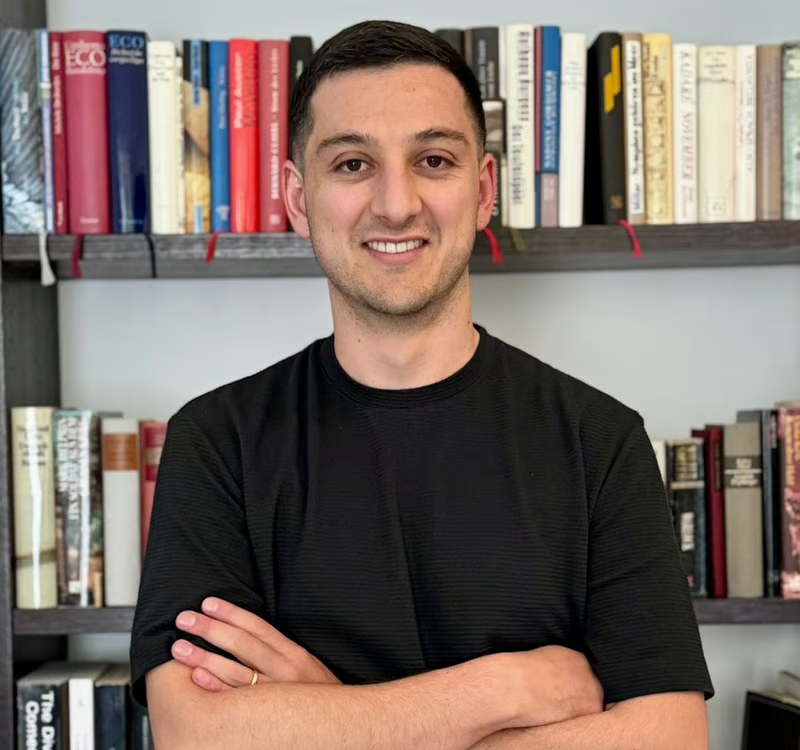

Turning the symptom into a masterpiece
On the subject of psychoanalysis, Darlyn tells us at the start of this interview, “he had his doubts”. He came to psychoanalysis on the recommendation of a relative who had previously explored it. And so, Darlyn found his analyst.
He goes on to tell us that, “for him, it was very difficult to trust another person enough to talk about what was going on inside him. Although it took quite some effort,” says Darlyn, “little by little this trust in his analyst began to take root and, with it, an in-depth process of work began.”
Today, our interviewee continues, “all of that has turned into a passion for psychoanalysis – for reading and constant intellectual engagement.” In recent years, he has made several changes to his life. “He has taken several new directions, as he wished. From closing down a business that was no longer viable, to solidifying his commitment to a-new love and his function as a father”.
Speaking of his process, he says, “It has been important to come to terms with the figure of the mother – havoc, as well as being able to forgive his father after fifteen years. Setting himself the task of moving beyond his father and giving himself the permission to do so.”
As for his daughter, who carries the name of love for wisdom, Darlyn supports her and encourages her in sport, “whilst she maintains discipline in what she does with passion”. His daughter “has been dreaming of travelling to Germany to practise that sport”. On this last point, the interviewee tells us, “this is not just any sport, but one in which my daughter has found a way to resolve something that arises from her uniqueness”.
In these final words, we glimpse something of what Domenico Consenza teaches us about the role of the father according to Jacques Lacan. The function of the father is far from being merely that misinterpreted and reductionist version of someone who introduces the norm on the child: “The father, as a symbolic function, is the one who stakes everything on the child as the subject of their own desire; he is the one who, by making an exception to the rule, says “yes” to the space of the child’s singularity as an irreducible and unprecedented subject” (1).
At the end of this interview, Darlyn expresses an interest in taking her analysis further, whilst wondering how far it can take him. That point at the end of the analysis where, according to Jacques Alain-Miller – referring to the symptom – he tells us that, in that case: “it is not an exit a way out, it is quite the opposite: a way of dealing with. Not to get out of, but to cope with. It is an art, that is to say, an artifice” (…) “the state in which there is nothing left to do but turn the symptom into a masterpiece”. (2)
_____________________________________________
References:
(1) DOMENICO COSENZA: Clínica del exceso, Barcelona, Xoroi Edicions, 2024.
(2) JACQUES ALAIN-MILLER: Piezas sueltas, Buenos Aires, Paidós, 2013.