


Mental Ser – a space for singularity
Psychoanalysis and Desire
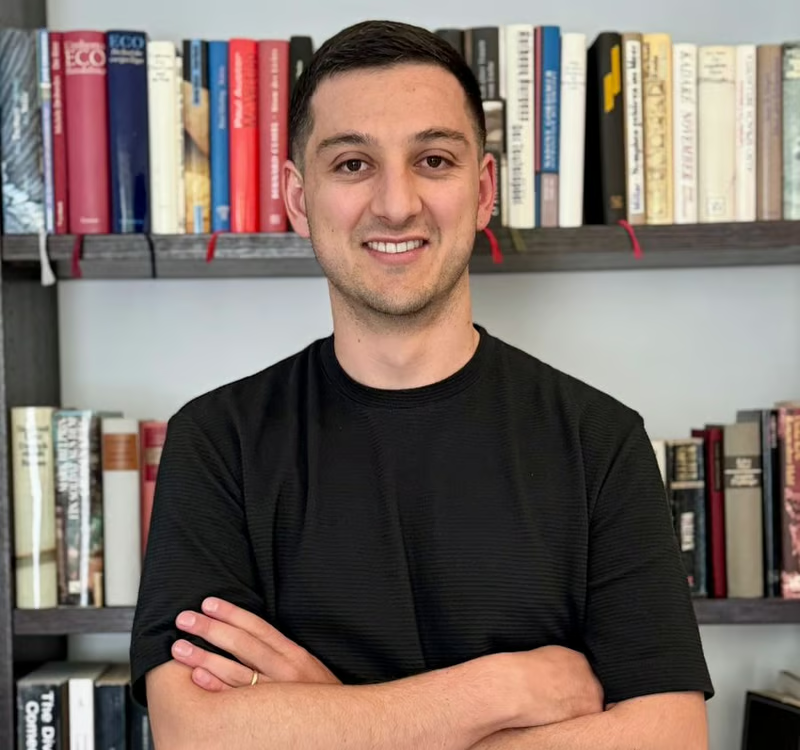
Mental Ser, say the founders Juan and Carlos, is a place for the subject, with a being-centred care model. They have an interdisciplinary working group, from areas such as psychiatry, general medicine, nursing, nutrition, psychology, social work and others, united under a psychoanalytical methodology.
From this, care plans are designed according to each human being and their uniqueness, that is, under the logic of one-to-one (Miller, 2006). They have two locations, one in the city of Medellín and a rural mental health hospitalisation clinic located in the municipality of Guarne, 45 minutes from Medellín and 10 minutes from José María Córdova International Airport.
Their working premises, based on psychoanalysis, focus on the subject and respect for their uniqueness. This is undoubtedly an example for those who seek to alleviate human suffering. Recently, we read an interview conducted by Página12 with Spanish psychoanalyst José María Álvarez, who highlighted precisely this type of contribution from psychoanalysis, ‘which, far from disappearing, is reinventing itself on the margins of the system.’
José María Álvarez, referring to the context of health policies, mentions how in Spain and Europe, immediacy and evidence-based criteria are prioritised, highlighting that ‘psychoanalysis resists with a radical proposal: to listen to the subject, to open space for desire, to uphold the value of the word’.
Mental Ser also supports this proposal and aligns with what Freud proposed at the Budapest Congress in 1918: the need for psychoanalysis for the people. In this case, it is achieved through institutional alliances, thereby demystifying the popular belief that psychoanalysis is elitist, which still holds true, at least in the German context.
More specifically, in the rural hospitalisation space, there is a system that enables different interventions tailored to each patient and their subjective states (Álvarez, 2020). In addition to adapting to what Domenico Cosenza considers essential in working with subjects of the time, where pathologies of excess predominate (Cosenza, 2024).
There, too, as Juan and Carlos tell us, ‘the aim is to create a space for the subject to take their first steps in what could become their invention. Here, there is a possible way out of the knot, which we seek to complete by accompanying the subject through the next logical stages in other stages.’
_____________________________________________________
Álvarez, J. M. (2020). Principios de una Psicoterapia de la Psicosis. Colección + Otra & Xoroi Edicions.
Cosenza, D. (2024). Clínica del exceso. Xoroi Edicions.
Miller, J.-A. (2006). La era del hombre sin atributos. Virtualia, Revista Digital de La EOL.
1 https://www.pagina12.com.ar/870821-la-argentina-es-el-futuro-del-psicoanalisis/