


‘Writing is my way of speaking, while remaining silent, clinging to life’.
Psychoanalysis and Desire
Juan Esteban Londoño has had a long relationship with psychoanalysis from different perspectives. As Jean-Claude Maleval says, although ‘certainly not all listening is psychoanalytic,’ despite ‘advocating respect for the singular and its non-resolution in the universal,’ they ‘nevertheless have one thing in common: they are based on listening to the other.’ Listening that now welcomes him, from a Lacanian orientation, that is, the orientation of causaAbock.
At a young age, Juan Esteban came to someone he now believes was an analyst. ‘I went there because the nightmares of my childhood kept me awake.’ He grew up in Medellín in the 1980s, ‘in a context where death was commonplace. Where we knew how to die and how to make others die, but we were never taught how to live’.
From there, however, ‘he has been guided by the desire to live.’ In one of his previous analyses and in life itself, writing became a mainstay. ‘It became a way of talking to all those I wanted to say something to and who are no longer in this world. So I write to them.’
That is why he also spent time in Germany, where he completed his doctoral studies in Hamburg. ‘In a context in which, as was his case, the past is not talked about much.’ The desire to live and write has ‘taken him to a context outside of death, to life.’
‘It is an ethical and aesthetic commitment outside of the commercial sphere. A way of breathing and living in difficult contexts.’ According to Juan Esteban, ‘it is also a way of naming images and saying what cannot be said, where it cannot be said.’
In writing, ‘he finds a way to enter turbulent waters, to pass through them, but to emerge into tranquillity. Writing is a way of speaking while remaining silent, clinging to life.’
Introduction
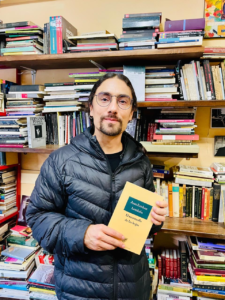
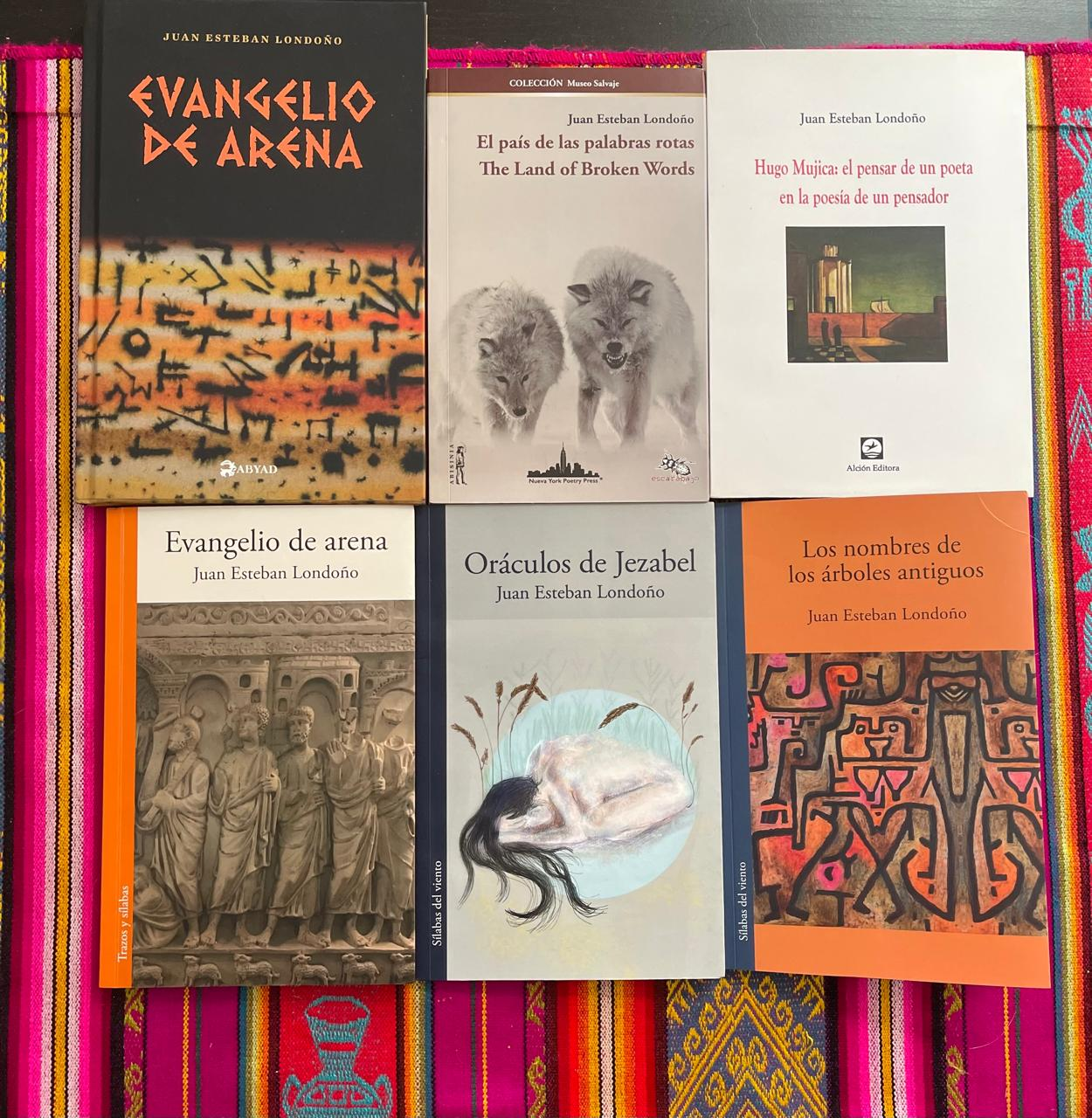
Juan Esteban Londoño (Medellín, 1982). Poet, storyteller and essayist. He has published the novel Evangelio de arena (2018), a poetic and sceptical interpretation of the historical events surrounding the emergence of Christianity, from the voice of a revolutionary character, Simon the Zealot.
Among his poetry collections is El país de las palabras rotas (The Land of Broken Words, bilingual Spanish-English edition, 2019), a journey through the landscapes of Germany and an exploration of the animalistic evolution of the psyche. Oráculos de Jezabel (2022) is a search into the feminine dimension of the psyche and a rescue of the women of antiquity in their drive to live like those devoured by history. Los nombres de los árboles antiguos (The Names of Ancient Trees, 2025) creates a history of philosophy in poetic form, seeking in authors such as Heraclitus and Lao-Tse, María Zambrano and Enrique Dussel the traces of the birth of thought and feeling in relation to the pain of the world.
The book El murmullo de las hojas (The Murmur of the Leaves) (2025) is an anthology that brings together unpublished poems, in homage to authors such as Marina Tsvetayeva and César Vallejo, stories from the context from which it comes, in a Medellín of the 1980s and 1990s, and literary essays on authors such as Antonin Artaud, Georg Trakl and María Zambrano.
Among Juan Esteban’s essay books are Hugo Mujica: el pensar de un poeta en la poesía de un pensador (2018) and La crucifixión en la literatura latinoamericana contemporánea: Hugo Mujica, Raúl Zurita y Pablo Montoya (2020), a work that has a German version entitled Kreuzesdeutungen in der gegenwärtigen Literatur Lateinamerikas: Hugo Mujica, Raúl Zurita und Pablo Montoya (2020), published by Missionshilfe Verlag.
Some of his books can be found on the Sílaba Editores website: https://silaba.com.co/autores/juan-esteban-londono/
His lectures on literature and philosophy can be found on YouTube: https://www.youtube.com/@juanestebanlondono3856