

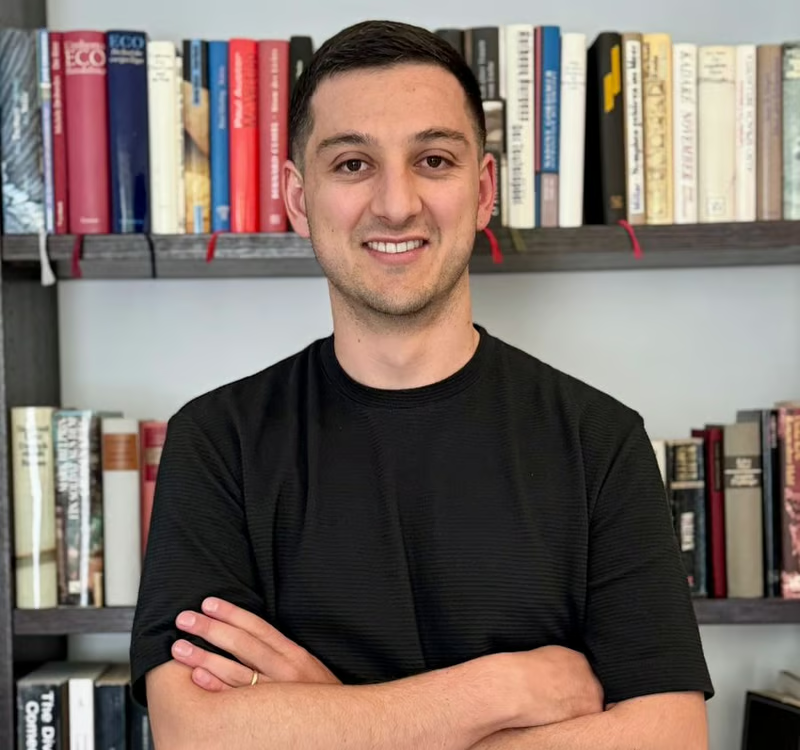

A possible encounter
Something as human, all too human, as suffering and the different manifestations of anguish have, since their invention by Sigmund Freud, found refuge in psychoanalysis.
For Carlos Jaramillo, his encounter with psychoanalysis came about from ‘a moment in his life when he had entered what is commonly called burnout and needed this refuge’.
Initially, this contingency led him and his wife to consult with ‘someone who, for an hour and a half, talked non-stop about his university degrees and his knowledge, without letting them say a word about their suffering’. He did not return there.
Later, Carlos says, ‘an encounter took place that was possible, despite how contradictory it may sound to many, in the Christian church, to seek a helping hand in psychoanalysis. However, he arrived there on the recommendation of someone who also attended that church.’
Carlos tells us that he found a listening ear and a desire to listen in his analyst Yoany Rendón, who, for him, ‘is someone who gave space to his suffering, without the intention or need to boast about his qualifications or knowledge’.
This coincides with the words of the psychoanalyst José María Álvarez (1), who says that Sigmund Freud managed to reverse the inertia of history precisely by putting himself at the service of suffering through listening.
According to José María Álvarez, he did so by ‘voluntarily relinquishing the position of know-it-all conferred on him by his knowledge and university degrees, [Freud] opted for the modesty of someone who agrees to be taught’. To be taught one-by-one, where each subject, in its singularity, possesses knowledge that cannot be found in textbooks.
For Carlos, feeling listened to ‘allowed him to get to the cause of what was happening to him.’ At the age of two, Carlos lost his father in a plane crash. ‘At the age of fifty,’ he tells us, ‘he understood more closely the importance of a-father.’
This is also a central theme in psychoanalysis. Lacan says that Freud’s desire to know concerned the question of what it means to be a father. Lacan would elaborate on the paternal metaphor, with the Name of the Father, as that which organises, from the symbolic, the entire field of subjectivity.
Jacques Lacan (2) tells us that the Name of the Father was not strictly speaking his invention, as it was already present in Freud’s work. This demonstrates the importance of the father as a function in psychoanalysis, and whose decline – as Lacan suggested, not as a lament for the loosening of family ties – has major effects at the social level (3).
Lacan’s (4) announcement was not made in a way that has been misinterpreted as promoting the restoration of so-called traditional families. On the contrary, Lacanian psychoanalysis seeks to live up to the subjectivity of the times (5).
The task of psychoanalysis, says Domenico Cosenza, is to ‘take a non-ideological perspective’. The attitude of psychoanalysis is not social conservatism, nor is it the subscription to experiments fuelled by a misguided desire (6).
This is something that other discourses ignore, whose recent publications have appropriated some terms from psychoanalysis, such as the Name of the Father, using them shamelessly even against their premises and without recognising their origin and, perhaps, without knowing what they are about. After this digression, we return to the interview.
At a very young age, Carlos was sent to live with his uncle in another city. According to him, ‘it was as if his mother knew about the importance of the paternal function and was trying to find a substitute in this way.’ Going ‘through four schools in two years, he couldn’t settle down.’
It was through religion and at a religious school, Carlos tells us, ‘that he was able to fill the void left by the loss of his father. That saved him from the abyss and kept him more in heaven than on earth.’
Despite having been a pastor in the church, where he had to preach to large audiences, Carlos said the absence of his father ‘made him a very shy person who had difficulty establishing relationships.’
In his encounter with psychoanalysis, he has understood how, in his search, he has, in a way, followed in his father’s footsteps. For example, ‘he studied aviation at the same university, chose the same place to live, the same type of car…’
For Carlos, ‘approaching religion has given him a helping hand in life’. From his readings on psychoanalysis, also a helping hand, he tells us that, although there are some points where the differences are very marked, ‘psychoanalysis has also found an ally in religion’.
Very apt words, as Freud put it, when he mentioned how, in the development of civilisation, religious doctrines have been fundamental in containing the death drive (7).
At the end of the interview, Carlos tells us that, from his experience with psychoanalysis, ‘he has found a helping hand to alleviate his suffering.’ He gives us, according to him, some points of agreement and differences between psychoanalysis and religious doctrines.
We quote Carlos’ words:
Agreements
- The exploration of the inner self. Religion from the perspective of sin and guilt. Psychoanalysis, through the exploration of the unconscious as a source of conflicts and desires.
- Both have an ethical stance. Christianity’s moral teachings are based on religion, while psychoanalysis can contribute to understanding the singularity and subjective nature of human behaviour.
- Both address the importance of relationships with others, albeit in different ways. Christianity emphasises love for one’s neighbour. Psychoanalysis studies how family relationships and social ties affect personal development.
- Both attempt to be a means of healing or cure. Christianity through faith. Psychoanalysis involves understanding the causes of individual suffering.
- Both propose a better relationship with life.
Difference
For Carlos, the most radical difference has to do with the source of authority and the concept of truth. ‘In religion, both answers are in the Bible,’ something that Carlos ‘considers dangerous, because by presenting itself as something unquestionable, it seems to him that it promotes slavery of thought.’
He has understood that, for psychoanalysis, ‘truth belongs to the subject and their history, their traumas, their discourse, and has nothing to do with an external revelation’. In his search for truth, he has devoted himself to writing. He is about to publish his book entitled: Padre (Father).
____________________
1. JOSÉ MARÍA ÁLVAREZ. Estudios de psicología patológica, Barcelona, Xoroi Edicions, 2017.
2. JACQUES LACAN. The other side of psychoanalysis, New York, Norton & Company, 2007.
3. JACQUES LACAN. La familia, Buenos Aires, Homo Sapiens, 1977.
4. JACQUES LACAN. La familia, Buenos Aires, Homo Sapiens, 1977.
5. JACQUES LACAN. «The function and field of speech and language in psychoanalysis», in Écrits, New York, Norton & Company, 2006.
6. DOMENICO COSENZA. Clínica del Exceso, Barcelona, Xoroi Edicions, 2024.
7. SIGMUND FREUD. «Die Zukunft einer Illusion» (1927), in Sigmund Freud. Gesammelte Werke, Band XIV, London, Imago Publishing, 1942.