


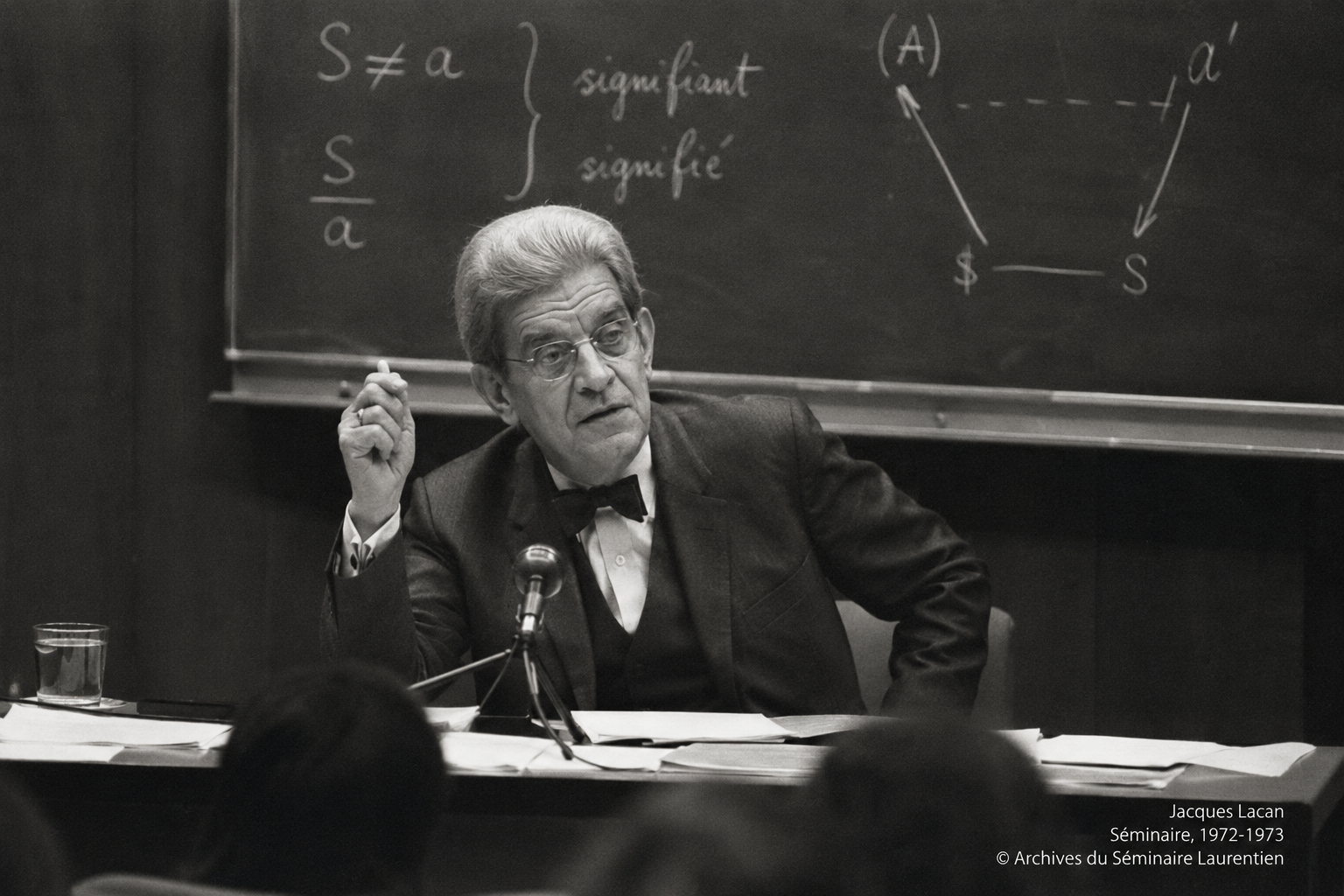
On Psychic Causality – Jacques Lacan
A presentation given at the seminar on Lacan’s Teachings.
Introduction.
Jacques Lacan’s article concerns his presentation at that 1946 congress to which he was invited by his friend Henri Ey, a French psychiatrist. The topic proposed by Ey: psychogenesis.
A few years later, in his Seminar 3 Psychosis (1955–1956), Lacan would say of this: ‘The great secret of psychoanalysis is that there is no psychogenesis. If that is what psychogenesis is, there is precisely nothing that could be further from psychoanalysis (1).
A few paragraphs further on, in the same seminar, one might read: a practice guided by psychogenesis sets the subject aside, focusing instead on the individual as an organism, “something objectifiable, a sufficiently limited field”. Lacan says: “Another way of expressing things, one that goes much further, is to say that the psychological is, if we try to grasp it as firmly as possible, the ethological, that is, the whole of the biological individual’s behaviours in relations to his natural environment” (2).
In psychoanalysis, however, it is about something more. “Freud´s teaching, (…) brings resources into play that are beyond immediate experience and cannot be grasped in any tangible fashion. In psychoanalysis, as in physics, it´s not the property of colour as sensed and differentiated by direct experience that holds our attention. It´s something which is behind this, and which conditions it”(3).
Some years later, referring to this type of practice that leaves the subject out, he would say in The Position of the Unconscious in his Écrits that they are the “vehicle of ideals: the psyche represents nothing more in them than the patronage that leads them to be described as academic. The ideal is the servant of society” (4).
Now, in his presentation On Psychic Causality, Lacan opposes the theory of his friend, Henry Ey. The latter, it seems, acting as a vehicle for these ideals, develops his organicist theory of madness. At the same conference, Lacan summarises his elaboration on psychic causality.
Let us begin.
Before delving into Lacan’s work, we shall begin this presentation by revisiting the concept of defence. We shall refer to the work of the psychoanalyst José María Álvarez, who in his book Estudios de psicopatología patológica (5), sheds light on this concept, which is as essential to psychoanalysis as it is to the whole field of psychopathology. This, moreover, resonates with the presentation given here.
Discussing defence mechanisms takes us directly to clinical structures as categories that enable us to gain an understanding of subjects’ experiences, whether they be so-called neurotics (normality), psychotics (madness) or those with perversions.
Following José María Álvarez, in a clinical practice guided by these categories, one can discern certain characteristics that assist the clinician in their work. We quote the author’s own words directly for greater clarity:
‘If we follow this proposal, we shall choose a clinical category that details the morbid signs and their hierarchy (clinical semiology), which is precise from a descriptive (nosography), which proposes a link between the clinical manifestations and the psychic mechanisms that underpin them (pathogenesis), which offers a coherent and well-founded account of the cause (aetiology), which provides a comprehensive explanation of that disorder and delineates the differences from others (nosology)’ (6).
Now, by mentioning clinical categories as a conclusion to this introduction, the aim is to establish the logical connection between the defence mechanism employed by the subject and these clinical categories or structures.
By saying ‘defence mechanism employed by the subject’, it is being suggested that the subject makes a choice. This was the view put forward by the father of psychoanalysis, Sigmund Freud, when discussing Neurosenwahl (7) – the choice of neurosis – in his Selbstdarstellung – Autobiographical Presentation. In other words, the subject is free and, above all, responsible. This will become apparent in the discussion of Lacan’s article that we shall be examining here.
From the above, it is clear that Freud far surpassed previous efforts through the innovations introduced in his work. José María Álvarez states that, ‘his [Freud’s] way of bringing unity to clinical categories or structures consisted in unravelling the generic psychic mechanisms that gave substance to the manifestations and in showing the pathways followed by the symptoms in their process of formation’ (8).
José María Álvarez tells us that, as a result, Freud discovered the forms of mental functioning that constituted this symptomatology. He termed these movements ‘defensive modalities’, whose subjective manoeuvres allow the subject a certain degree of relief and a certain balance in the face of the drive impulse.
This defensive action undertaken by the subject “is directed against a representation or series of representations that are incompatible, painful and unassimilable. It is, therefore, a defensive strategy whose final outcome determines a type of mental functioning and entails the establishment of a specific form of psychological pathology” (9).
In the words of José María Álvarez, it is a stratagem for maintaining a certain state of ignorance, upon which ‘the type of psychic structure in which the subject takes refuge will depend; this implies a particular way of relating to that driving force of life which is desire and, furthermore, gives rise to specific symptoms’. Likewise, the possible failure of the defence and the return to the subject of that which they have chosen not to know (10).
Here, the concept of freedom, from a psychoanalytic perspective, becomes fundamental. For it is a freedom that is not given from the outset, but rather a freedom to be conquered, as José María Álvarez puts it. A freedom that Lacan also attributes to the subject in their choice of madness and as something they have not yet conquered due to the immediacy of their identifications.
Defence is thus posited from the outset as a subjective decision and, consequently, the subject’s responsibility; thanks to Freud, ‘madness ceased to be regarded as a disease similar to others and came to be understood as a defence that some people require. This was the starting point for the first thorough, coherent psychological treatments, grounded in a lucid theory that was, on the whole, fairly well established’ (11).
Unlike neurosis, where the defence mechanism is Verdrängung, psychosis or madness (Verwerfung) is a more radical defence, which on more than a few occasions leads the subject to withdraw into solitude. To regard ‘madness as a defence’ implies that the approach to the psychotic and the treatment of psychosis depend directly on that view’ (12). Here, the clinician’s task ‘consists in reaching out a helping hand’, for, for example, in the field of delusion, analysis teaches us that ‘behind those ideas, as strange as they are cherished, someone is struggling to cling to life’ (13).
1. Critique of an organicist theory of madness
Lacan begins by reminding Henri Ey that, although they had started out together defending similar epistemological positions, by the time of that conference—the Bonneval Psychiatric Colloquium on 28 September 1946—the situation was no longer the same.
In fact, referring to Ey’s 1936 publication in *L’Encéphale*, he tells him that, ‘everything that brought him [Henri Ey] closer—and was bound to bring him ever closer—to a doctrine of mental disturbance which I [Lacan] consider incomplete and false, and which designates itself in psychiatry by the name of organicism’ (14).
The theory underpinned by Henri Ey’s organ-dynamism, according to Lacan, rests on the endeavour to ‘express the form of a relationship between function and variable’, as a constituent of determinism regarding the genesis of mental disturbance.
Thus, organ-dynamism, guided by the notion of necessity, strives to find evidence in the ‘chemical, anatomical, etc., conditions’ of the generative cerebral process specific to ‘mental’ illness, or even in ‘the lesions that impair the energetic processes necessary for the unfolding of psychic functions’ (15).
It is at this point that Lacan cites the example of a patient who, as a result of an injury, had damage to the area of the brain responsible for processing visual information. Although he could see objects, he was unable to understand what they were or what they meant.
However, Lacan notes, the patient could recall with nostalgia certain “religious and political speculations that had been forbidden to him”, managing to achieve certain objectives he no longer understood, clinging “to the stock of language to overcome some of his agnostic deficits”. Here, Lacan asks Ey how he distinguishes this neurological patient from a madman. Implies that the patient was engaged in a process of logical construction.
As José María Álvarez explains, what Henri Ey proposes is a model of ‘functional disintegration’, according to which mental disorders appear as a result of decompensations or dissolutions of the ‘psychic body in which the conscious being constitutes the form’. In this organ–dynamic approach, so favoured by psychiatric psychopathology, mental pathology is conceived as a combination of negative or deficient signs—an immediate manifestation of organic impairment—and positive signs of the liberation of inferior and archaic functions” (16).
Let us recall the defence. With the above in mind, to cite an example and once again following the words of José María Álvarez regarding the schizophrenic pole of psychosis. Henri Ey prefers to position himself ‘within radical mechanistic theory’, whilst the Freudian conception ‘seems unacceptable to him; he is so repelled by the idea that psychic causality might extend to schizophrenia that it provokes indignation in him’ (17).
For Ey, “illnesses are insults and obstacles to freedom; they are not caused by free activity, that is to say, they are not purely psychogenic”. This offers a glimpse of the determinism proposed by his theory, to which Lacan would respond a few lines later by alluding to the unconscious.
He does so with the following words, and with a certain mocking tone: “My unconscious leads me, with the greatest of ease, to displeasures to which I do not intend to attribute any significance whatsoever, at least until I come to terms with it through the refined methods of psychoanalysis”. Here, between the lines, he posits an unconscious determinism.
At the same time, he reminds him that in an articulation of the psyche—such as that proposed by Ey—between belief and an ideal, “a vital programme is set in motion that is as repugnant to logical judgement as it is to moral conscience, designed to produce a fascist and, at times, quite simply, a fool or a thief”.
Lacan goes on to argue that both Ey’s proposal and the debates held at that congress, despite their apparent intellectual rigour and dialectical quality, lack “the character of the true idea”. This question of truth “essentially conditions the phenomenon of madness and, if one seeks to sidestep it, one castrates this phenomenon of signification, with the aid of which I [Lacan] intend to show that madness has to do with the very being of man” (18).
2. The essential causality of madness
Lacan establishes a certain indissoluble role for belief as the driving force behind hallucination and delusion. This is something Ey does too; although he initially regarded belief as the essential driving force behind both phenomena, he subsequently dissolves the notion of belief into that of error. Ey goes so far as to characterise phenomena such as hallucination as an abnormal sensation, “‘the fundamental error’ of delusion”, “an object situated in the folds of the brain”.
In light of this, Lacan reminds Ey that, whilst it might be said that error is a deficit, the same cannot be said of belief; this is not the case. “Belief can go astray at the very height of a thought without any deviation.” That is to say, as Ey illustrates with his earlier remarks.
It is at this point that Lacan reiterates that these are phenomena that directly concern the subject, who, having no means whatsoever to express them, finds them translated into his or her perplexity; as an interrogative gap inseparable from the register of meaning.
Or, in other words: “the phenomenon of madness is inseparable from the problem of signification for being in general, that is to say, from language for man”(19). Of which, in his Seminar 3, he would say: “From the Freudian point of view man is the subject captured and tortured by language”(20).
According to José María Álvarez, one of the maxims “of Lacanian thought is that the signifier comes first and the subject is its effect; or, put another way, that the subject of language precedes the subject of the idea” (21).
Lacan then returns to his doctoral thesis, the Aimée case. In this, he demonstrated the clinical entity he termed ‘self-punishing paranoia’. The patient, moreover, was the central figure in her fictional works, which Lacan himself was able to study at close quarters.
“She is going to strike with murderous intent at the very last of the people in whom she has identified her persecutors, and that act, after the time necessary for her to become aware of the high price she pays in the abject conditions of prison, has the effect of causing the beliefs and phantoms of her delusion to collapse within her” (22).
In other words, she ends up attacking her own idealised image in the mirror. ‘The object she strikes is none other than the kakón of her own being’.
There is something here that must be traced through the immediacy of this identification, ‘to put it bluntly, the subject’s infatuation’. It is an identification, without mediation, in which nothing more and nothing less than signification is inscribed. Something that Ey has overlooked, reducing it to its organic determinism.
Here, identification is what sets the cogs of madness in motion. ‘For the risk of madness is measured by the very allure of the identifications in which man commits both his truth and his being.’
With this, Lacan argues that ‘far from madness being a contingent fact arising from the fragility of his organism, it is the permanent virtuality of a fissure opened up in his very essence. Far from being ‘an insult’ to freedom, it is its most faithful companion; it follows his every move like a shadow. And not only can man’s being not be understood without madness, but it would not even be man’s being if it did not bear madness within itself as the limit of his freedom. Identifications and madness’.
Thus, Lacan, like Freud, also attributes the cause of madness to “that unfathomable decision of the being in which it either comprehends or remains unaware of its liberation, towards that trap of fate which deceives it regarding a freedom it has not yet conquered”.
3. The psychical effects of the imaginary mode
Here, from the mirror stage onwards, that discordance between reality and the ideal is established. It is here that the concept of immediate identifications becomes somewhat clearer, through the function of the imago—that relationship between reality and the organism.
Lacan points out that ‘science blithely confuses the “I” with the subject’s being; we can now see where we diverge from the more common conception, which identifies the “I” with the synthesis of the organism’s relational functions’. That is to say, leaving out its subjectivity’. Whereas that subject, ‘the “I”, is not a being, but something attributed to which it speaks’ (23) within the subject. That is to say, its unconscious.
At this point, Lacan elaborates one of his earliest approaches to his theory of the mirror, beginning with the premature development of the human being and the anticipation inherent in the structure of an identification with the image.
Lacan draws here on phenomena of transitivism to show, for example, how children claim to have been struck when they see another child being struck. It is from these ideal identifications that the ‘I’ is formed, comprehensible only through its imaginary structure. Thus, the first effect of the imago is one of alienation of the subject.
It is grounded in a form of causality, which is psychic causality itself: identification.
__________________________________________________________
Bibliography:
- LACAN, J.: The psychoses. The seminar of Jacques Lacan / Book III. Edited by Jacques-Alain Miller, New York, Norton, 1993.
- Ibid.
- Ibid.
- LACAN, J.: «Position of the Unconscious» (1964), in Écrits, New York, Norton, 2006.
- ÁLVAREZ, J.: Estudios de psicología patológica, Barcelona, Xoroi Edicions, 2017. Ab Dezember 2026 auch auf Deutsch erhältlich unter dem Titel: Studien der pathologischen Psychologie unter https://artemisaverlag.com/product/studien-der-pathologischen-psychologie/.
- Ibid.
- FREUD, S.: »Selbstdarstellung«, in Sigmund Freud. Gesammelte Werke, Band XIV, London, Imago Publishing, 1942.
- ÁLVAREZ, J.: Estudios de psicología patológica, Barcelona, Xoroi Edicions, 2017. Ab Dezember 2026 auch auf Deutsch erhältlich unter dem Titel: Studien der pathologischen Psychologie unter https://artemisaverlag.com/
- Ibid.
- Ibid.
- ÁLVAREZ, J.: Prinzipien einer Psychotherapie der Psychose, Mössingen, Artemisa Verlag, 2026.
- Ibid.
- ÁLVAREZ, J.: La Invención de las Enfermedades Mentales, Barcelona, Gredos, 2008.
- LACAN, J.: «Acerca de la causalidad psíquica» (1946), in Écrits, Mexico, Siglo XXI, 2009.
- Ibid.
- ÁLVAREZ, J.: Estudios sobre la psicosis (5th ed.), Barcelona, Xoroi Edicions, 2006. Ab Oktober 2026 auch auf Deutsch erhältlich unter dem Titel: Studien zur Psychose unter https://artemisaverlag.com/
- Ibid.
- LACAN, J.: «Acerca de la causalidad psíquica» (1946), in Écrits, Mexico, Siglo XXI, 2009.
- Ibid.
- LACAN, J.: The psychoses. The seminar of Jacques Lacan / Book III., a.O.O.
- ÁLVAREZ, J.: Estudios sobre la psicosis (5th ed.), Barcelona, Xoroi Edicions, 2006. Ab Oktober 2026 auch auf Deutsch erhältlich unter dem Titel: Studien zur Psychose unter https://artemisaverlag.com/
- LACAN, J.: «Acerca de la causalidad psíquica» (1946), in Écrits, Mexico, Siglo XXI, 2009.
- LACAN, J.: Encore. On feminine sexuality, the limits of love and knowledge. The Seminar of Jacques Lacan / Book XX. Edited by Jacques-Alain Miller, New York, Norton, 1972.