


A Bridge towards Love
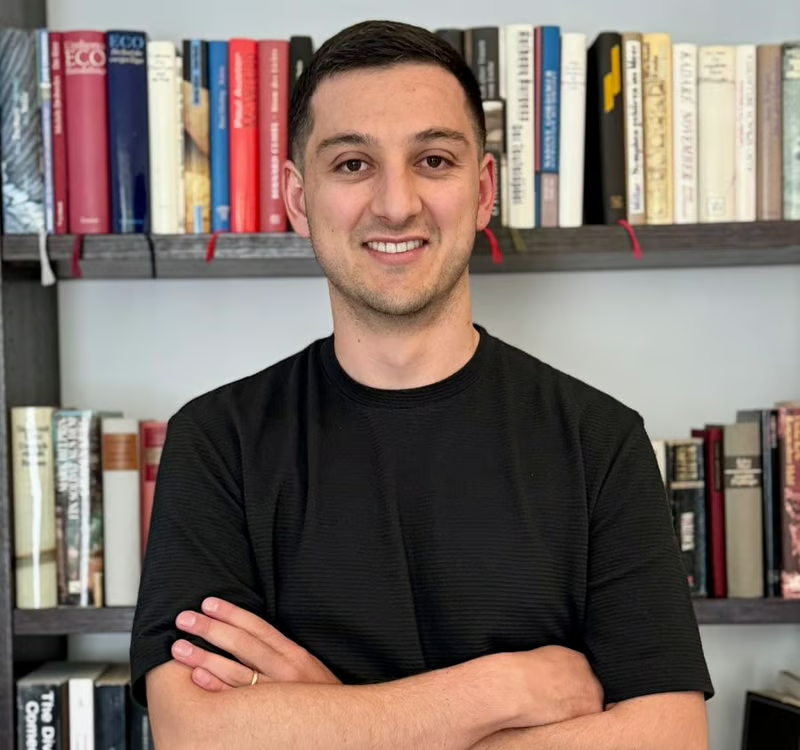
Eliana begins this interview by telling us that, in her life, “she had never had any kind of accompaniment related to psychology”. She came to psychoanalysis on the recommendation of a friend, “who was in analysis with Yoany Rendón – now her psychoanalyst”.
Specifically, she says, “there was something I wanted to resolve or find an answer to. It’s about,” Eliana continues, “understanding why, even though I know I’m a woman who’s perfectly capable of getting things done, I always tended to put off the most important things in my life – to the point of becoming paralysed”.
Speaking of her process, she tells us, “there have been times when I’ve come to hate it”. Well, according to her, “it’s not easy to face what you’ve been running away from without wanting to confront it. That thing you’d rather not know about, because you thought that by putting it aside you’d live better, you’d be happy”.
However, “by understanding a little more, by holding on and giving the process time whilst respecting its own logical timing, the hatred is followed by love. To the point of always feeling grateful for being able to understand what one has been running away from. To be able to move forward”.
Her words echo those of the psychoanalyst Jacques Lacan, who tells us that, indeed, “one knows nothing of love without hate” (1). Lacan says this precisely to emphasise that the function of knowledge in the unconscious allows hate to be put in its place. Let us be clear, for here many might seek to justify wickedness.
Having separated love from hate during analysis—and thanks to the function of this unconscious knowledge—one might envisage access to a-cure or a better relationship with life. Indeed, Freud himself suggested to Jung in their correspondence that psychoanalysis “is, in reality, a cure through love” (2).
The important thing, as Eliana rightly says, is “not to stop there. To be able to see and understand, as her analyst tells her; something for which it is necessary to go through those very places too—the points where one feels uncomfortable”. A way through which one had to pass, which, once understood, Eliana continues, “implies taking action, precisely in order to keep moving forward”.
The interviewee says that psychoanalysis has come to permeate many aspects of her life. Moving on from this last statement to her work. In other words, weaving together the previous statement with the path towards aspects of her life in which she finds a possible way out, a choice.
Eliana says that “she is dedicated to connecting medical services with patients who require them”. In other words, she acts as a bridge between those seeking the medical assistance they need to cure an ailment and those who can lend a hand in that search.
This is a significant signifier, for by placing herself at the service of Eros to preserve life, she has made a decision to stand in favour of love. This is in keeping with the words of the philosopher Friedrich Nietzsche, who said that, “the greatness of the human being lies in the fact that they are a bridge and not an end; what can be loved about the human being is that they are a step and a transition” (3).
A way through which one had to pass, to keep walking, to cross the bridge towards love.
Bibliography:
(1) JACQUES LACAN.: The Seminar of Jacques Lacan. Buch XX: Encore: On Feminine Sexuality the Limits of Love and Knowledge, New York, Norton, 1998.
(2) FREUD, S y JUNG, C. G.: Briefwechsel. Herausgegeben von William McGuire und Wolfgang Sauerländer. Frankfurt/Main, Fischer Verlag, 1984.
(3) NIETZSCHE, F.: »Also sprach Zarathustra«, in Nietzsches Werke, Band I, Salzburg, Das »Bergland-Buch« Verlag, 1952.