

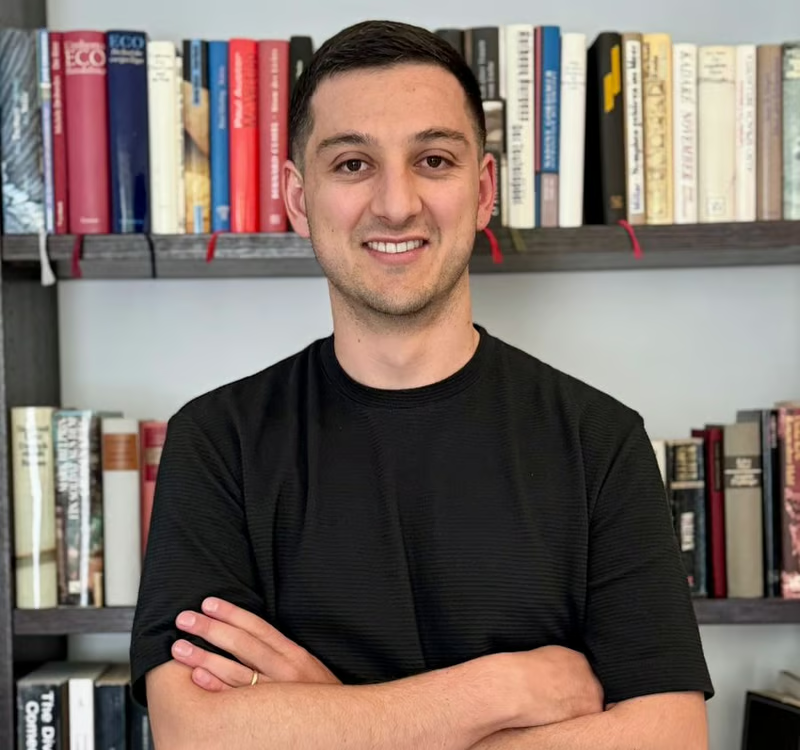

“A heartfelt note about my journey”
This article is written by Sergio Zuluaga.
Fifteen years ago (I’m now 44), episodes of anxiety led me to seek help and realise that these heightened fears—which arise from anticipating certain situations in life—need to be managed. Along the way, I quickly realised that psychology based on repetitive techniques, tasks akin to what is now known as coaching or personal self-improvement discourse, was not for me. That was how I began seeing a psychologist with an affinity for psychoanalysis who, as he explained to me, belonged to a post-Freudian current of thought. As it was an episodic form of distress, according to my view at the time, there was never a sustained dialogue lasting more than two or three consecutive sessions. We would discuss the prevailing fear at a particular moment in my life, based on my personal history and the context of the events that triggered my anxiety.
I can say that those conversations were very important insofar as they allowed me to recount my life story, to understand some primary sources of distress, and for questions to arise that have driven my self-knowledge. However, viewed in hindsight and given my lack of theoretical knowledge, I am left wondering whether the post-Freudian approach entails a certain flexibility that prevented me from ‘going to the bottom of things’. Little by little, as the acute or very conscious anxieties subsided, I stopped having those conversations.
This is how my life went until, in early 2025, something relatively new took hold of me. Although I recognise a certain melancholy prevailing within me, the meaning of life had never demanded itself of me in such a way that it imposed itself as constant sadness or a lack of motivation. The “what for” of existence opened up as a piercing question which, paradoxically, closed in on itself through its own forcefulness: I could not, or did not want to, set out on that path of delving deeper into myself to address it. Sadness, mixed with immobility, gave way to the familiar episodes of anxiety and I found myself caught up in what might be called an emotional crisis.
For the first time, then, I considered the option of seeking help from psychiatry, and I did so with great reservations. It means entering another logic, perhaps far more schematic and one which, I admit, strips the patient of their uniqueness: a diagnosis of anxiety and depression arising from a 30-minute conversation, and a standardised treatment based on a biochemical reality that takes precedence over the dialogical and the human, strictly speaking. Yet, I must acknowledge it: the distress diminishes considerably. This last statement, it is also true, would require many footnotes, which I shall venture to condense into the intuition that, if such treatment shifts from being temporary to permanent, life can become a perpetual evasion that erases the nuances and tends to render singularity invisible.
On the recommendation of the very psychiatrist treating me, and with the intention that the treatment should be temporary, I sought a different alternative and ended up with the analyst Yoany Rendón. After a cycle of ten sessions and the start of a second cycle, I feel I have regained my desire to set out on the path using my own tools. From the very first sessions, the concept of ‘structure’—which, as I understand it, forms part of the Lacanian school of psychoanalysis—has allowed me to visualise something akin to a backbone of my life story: the impossibility of betraying the father, identification with certain semblances, the pursuit of the impossible as a source of anxiety and jouissance and, ultimately, as a negation of life, now appear as constituent parts of that structure which I must acknowledge in order to face it head-on and ‘carry on living, more fully alive’.
Something fascinating that has happened during this analysis is that, as the conversation yields new ideas, the unconscious manifests itself in dreams, forming a symbolic meta-narrative that distils desires and, though it may sound paradoxical, moments of clarity. It is like gaining access, for the first time in my life, to the language of desire. And the symbolic, rather than concealing that desire, defines it and renders it transparent. In a short space of time, some dreams have even shown me that the vessel and the wind are aligned to reach a safe harbour.
I infer that this school of psychoanalysis, on the other hand, does not encourage the analyst to be complacent with the analysand, in the sense that they do not avoid confronting them, facing them with uncomfortable silence, or traversing rocky terrain more than once. I feel this is the only way to ensure the conversation is not always an epic tale with premeditated dramatic twists, in the best Aristotelian style, but rather imperfect; and that in that imperfection, it lays bare the uniqueness of the person questioning their life.
One final aspect I would like to highlight regarding my particular case is the burst of vitality that this analysis has sparked in my appreciation for the world of ideas and books, which I had abandoned since the crisis described in these paragraphs. Psychoanalysis itself, as a subject of study, has aroused great interest in me, to the point that I have joined study and outreach groups where I have greatly enjoyed practising what I call ‘intellectual tourism’ around a subject about which I know very little.
Likewise, my motivation for reading in general has increased, as has my drive to strengthen my own long-standing initiatives to promote reading and writing: a creative writing group with older people, a weekly book club in the town where I live, and a blog that several friends and I set up where we creatively review our individual reading experiences.
For further information about the creative writing group or the reading club, please contact Sergio on +573127762003. Link to the blog: https://lesapomagacin.com/.