


A subject, marked since childhood by the desire to make a trip across the Atlantic, managed in 2013, at the age of 23, to take his first steps in that direction. This trip, until then, “impossible” (according to the analysand), consisted of a group academic visit to universities and research centers in Germany.
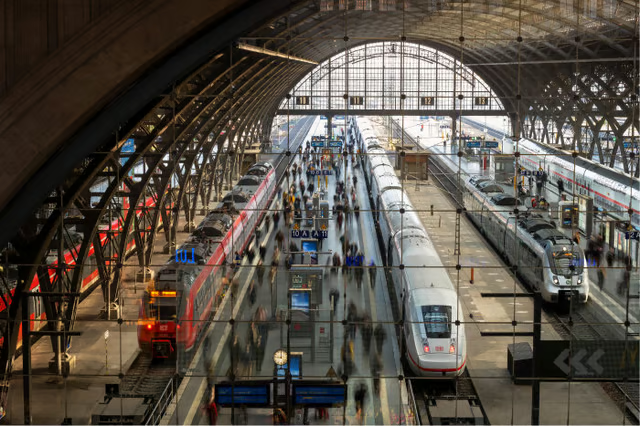
After passing through several cities, it was in Leipzig, that this desire to “travel” was transformed into an aspiration to one day move there. This thought was inspired, albeit unconsciously, by a scene seen while waiting for his train at the central station of that city.
As he turned his gaze to another of the waiting platforms, he was captivated by a couple with their two children; the subject observed how the youngest ate a piece of bread comfortably seated in his trolley while his parents concentrated on their books.
After completing the rest of the scheduled visits, the man returns to his home country. Although the feeling awakened in Leipzig was still alive, like an intense fire that seemed impossible to extinguish, it slowly faded almost to the point of extinction.
After a few years, the subject, completely absorbed in the activities of his life at the time, not only began to feel “an uneasiness” (his uneasiness) but also an irritability that affected those around him. Although successful in his work activity, which he had considered the desire of his last years, he had come to psychoanalysis with the “feeling of being dead” because at least his desire was.
From the train station to the airport.
Through his encounter with psychoanalysis, the subject had gradually begun to understand the reasons for “his uneasiness”. In addition, he could slowly recall the desire suffocated by the “distraction” (1) and the forgetfulness of that scene at the central station.
The latter had offered him the possibility of glimpsing a future-present, seeing himself in that couple that, besides forming a family, brought with them the signifier of knowledge. The scene not only offered the subject a manifestation of his unconscious through that family/knowledge signifier but also invited him to act in consequence with that desire that dwells within him.
He thus consciously awakened the desire to move to that country, and there remained in his unconscious the desire to find his “a new love” directed towards knowledge. After some time, with good analytical work accompanied by courage, the question asked by his analyst and Lacan himself becomes a constant: Have you acted according to your desire? (Lacan, 1997, p. 314).
Strongly moved by the results of the analysis and by his desire, he packed his bags for a trip that “did take place” beyond the “impossible” that it was for that man. Years later, in Leipzig, with whom he had begun a great friendship through books/knowledge, the subject was able to establish his family.
It should also be remembered that, as desire constantly moves, it implies the need to act anew. Therefore, at present, the subject continues to ask himself whether he has acted ethically, that is to say, in conformity with the desire that dwells in him.
Notes.
1) In reality, it constitutes a reaction of a significant number of people who flee from what they dream of once they have the possibility of realizing it (Freud, 2001). The subject, having made his first trip, for a long time considered “impossible”, had unconsciously made it “impossible” and renounced that new step that was offered to him in his desire, the move to this other country.
Bibliography.
Freud, S. (2001). Sigmund Freud Obras Completas VII. Fragmento de Análisis de un Caso de Histeria (Dora), Tres Ensayos de Teoría Sexual y Otras Obras (1901 – 1905). Amorrortu Editores.
Lacan, J. (1997). The Ethics of Psychoanalysis (1959-1960). The Seminar of Lacan / Book VII. Edited by Jacques-Alain Miller. Norton.